

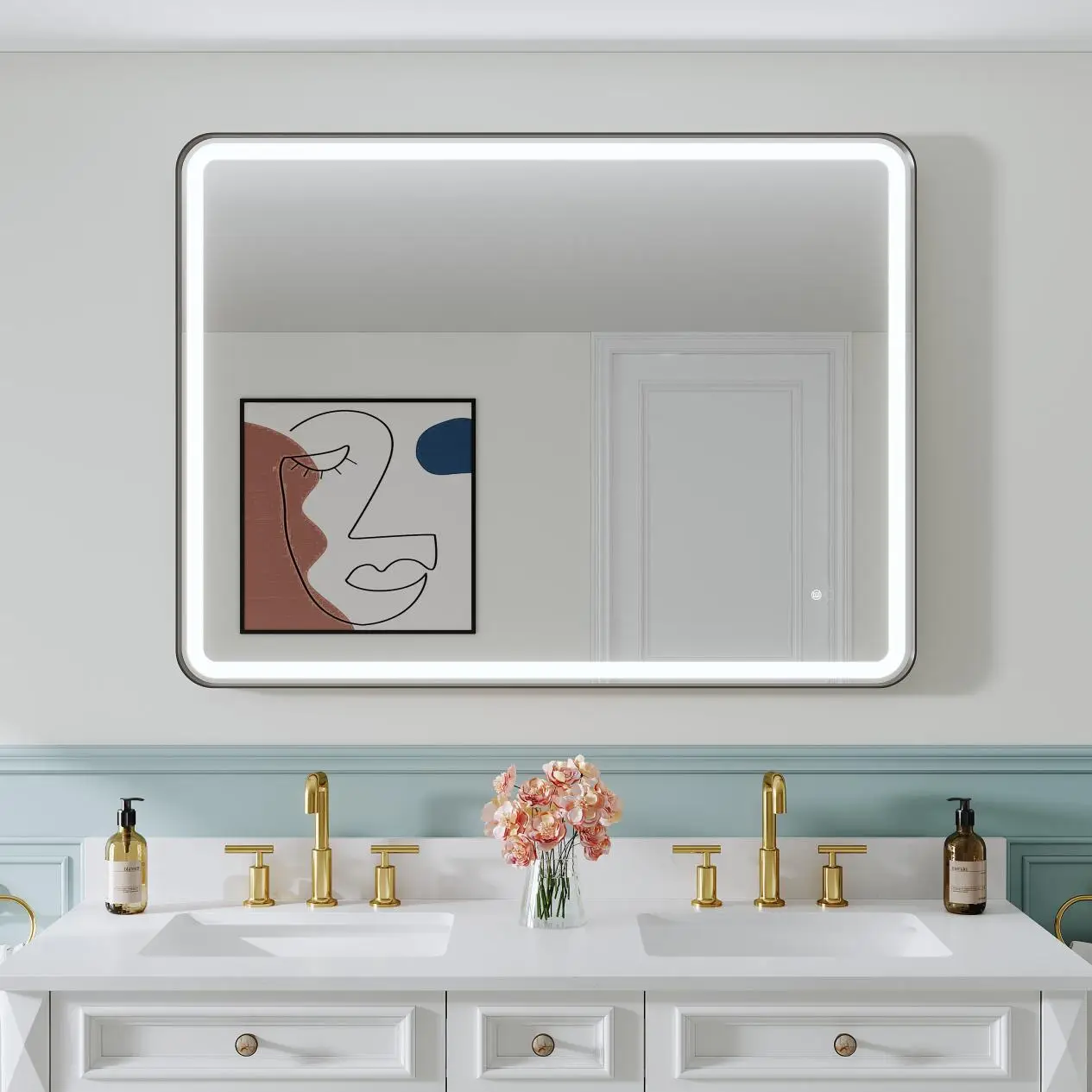
In recent years, as the residential renovation market and the smart home industry have heated up, the lighted led mirror has gradually shifted from “decorative products” to “functional lighting cores”. The industry standard around its core indicator – lumens – is undergoing a round of refined restructuring. So, how many lumens should an LED mirror achieve? Behind this issue lies the transformation of the lighting industry from “brightness-oriented” to “visual experience-oriented”.
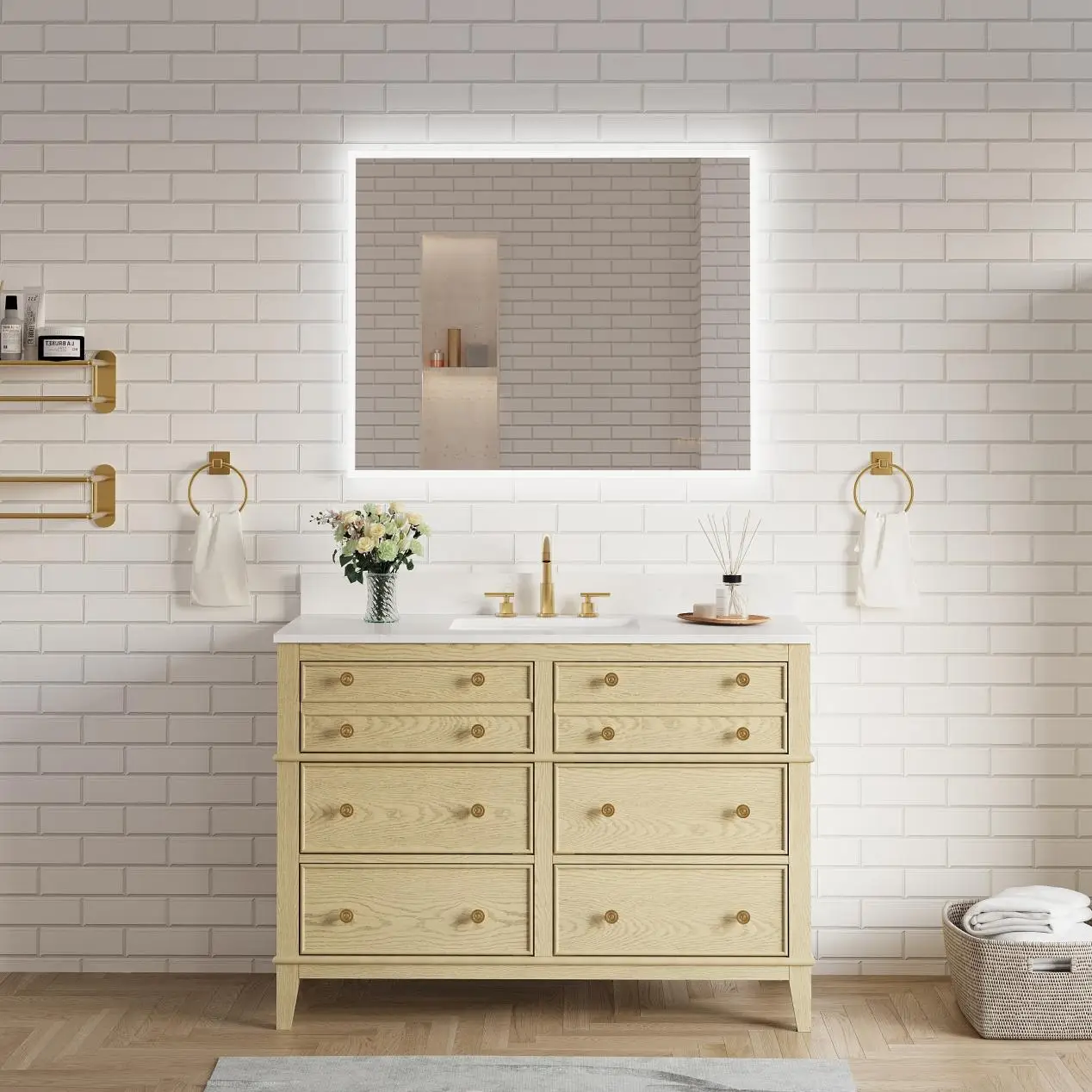
1. From “Lumen First” to “Illuminance Priority”: Industry Awareness Upgrade
Traditional lighting procurement often uses lumens as the core indicator, but in the field of LED mirrors, this logic is being revised. The Illuminating Engineering Society (IES) recommends using “lux” as the final measurement standard, which refers to the actual intensity of light shining on the face.
The consensus in the industry is:
The ideal facial illumination should be 300-500 lux
Under this standard, lumen is no longer an isolated indicator; it must be calculated comprehensively based on mirror size, light-source position, and diffusion efficiency. For example, a common 24 × 36 inch LED mirror typically requires:
Approximately 2000-4000 lumens total output
This marks a shift in the industry from being “bright or not” to being “visible or unclear”.
2. Mainstream Luminous Range: Layered Standards for Different Application Scenarios
According to US and global supply chain data, the demand for lumens of LED mirrors shows a clear stratification:
1. Basic Usage Scenarios (Daily Household)
Recommendation: 700-1200 lumens
Applicable: grooming, simple care
Features: Soft, low glare
This range is considered an “industry standard safety value” that meets daily needs while avoiding visual fatigue.
2. Professional Dressing/Makeup Scenes
Recommendation: 1200-1800 lumens
Applicable: Fine makeup and skincare
Features: High color rendering+high uniformity
Research shows that if the makeup environment is below 1000 lumens, the ability to recognize details significantly decreases.
3. Main Lighting Type Mirror (Without Additional Light Source)
Recommendation: ≥ 3000 lumens
Applicable: Small bathroom main light source
Characteristic: Requires a high diffusion design
In the apartment market, more and more developers are adopting the “mirror as the main light” design to reduce the configuration of chandeliers and wall lights.
4. Atmosphere/Decorative Mirrors
Recommendation: 500-700 lumens
Applicable: hotels, SPA, Emotional lighting
Characteristic: Emphasize visual comfort
This type of product emphasizes design over functionality.
▶ Case Study: Bathroom Lighting Renovation in a Los Angeles Boutique Apartment
In 2025, during renovations of a mid- to high-end apartment complex in Los Angeles, the existing bathroom lighting system was upgraded. The developer originally installed an LED mirror with approximately 800 lumens of output, intended solely for basic daily use.
Observed Issues:
Users reported insufficient lighting for morning makeup application.
Pronounced facial shadows were evident, particularly around the chin and eye areas.
Users frequently needed to switch on additional overhead lighting for assistance.
▶ Proposed Solution
The project team subsequently replaced the original fixture with:
A hybrid front-and-backlit LED mirror with an output of 1,500 lumens.
A Color Rendering Index (CRI) of ≥90.
Integrated stepless dimming functionality.
▶ Renovation Results (Data Feedback)
According to subsequent user surveys conducted by the developer (sample size: approx. 120 households):
Overall user satisfaction increased by approximately 32%.
The proportion of users relying on the mirror as a *single* light source for makeup application rose from 45% to 78%.
The frequency with which users needed to switch on additional lighting decreased by approximately 40%.
Concurrently, measured average facial illuminance increased from approximately 220 lux to nearly 400 lux—bringing it within the industry-recommended range.
▶ Key Conclusions
This case study demonstrates that:
An output of 800 lumens (basic level) is adequate for “functional use,” but insufficient for “precision tasks” (such as makeup application).
The 1,500-lumen range represents a “transformative leap in user experience” for the majority of households.
Increasing lumen output must be accompanied by optimized light distribution; otherwise, the resulting improvement in lighting quality will be limited.
3. Key Variable: Why Is There a Huge Difference in the Effect of “Same Lumen”?
The latest market research shows that even with the same lumen, the experience difference between different products can reach more than 30%, mainly due to:
1. Diffusion Loss
LED mirrors typically use frosted glass or acrylic diffusion plates, which can result in a loss of approximately:
15% -30% luminous flux
This means that the nominal 4000 lumens may actually be perceived as only around 2800 lumens.
2. Design of Light Source Position
Edge lit: softer, but with lower center brightness
Front lit: more direct, but prone to glare
The industry trend is towards a hybrid design (front and back).
3. Uniformity
High-end brand requirements:
≥ 85% brightness uniformity
Otherwise, there will be a “hot spot effect” that affects makeup judgment.
4. Color rendering index (CRI)
Recommendation: CRI ≥ 90
Otherwise, the skin color distortion will be severe
This is particularly crucial in the beauty retail and hotel industries.
4. Market Trend: Parallel Integration of Intelligence and High Luminosity
According to the 2025-2026 bathroom industry report, the LED mirror market presents three major trends:
1. High Lumen and Adjustable Brightness Become Standard Features
Consumers no longer accept “fixed brightness” and tend to:
Morning high brightness (1500+lumens)
Low brightness at night (500 lumens)
2. Integrated Intelligent Control System
including:
Touch dimming
Automatic memory brightness
Linkage with smart homes
3. Explosive Demand in the Commercial Market
In hotel and apartment projects, LED mirrors have become a “standard configuration”, especially in:
boutique hotel
long-term rental apartment
Medical Beauty Space
The core reason is that:
Energy saving (low power consumption of LED) + space saving + improved user experience
5. Industry Controversy: Is Brighter Better?
Although high lumens have become a trend, there is also controversy in the industry over “excessive lighting”.
Experts point out that:
Exceeding 4000 lumens may cause glare
Highly reflective environments are prone to visual fatigue
The correlation between user satisfaction and “uniformity” is higher
Put it another way: Lighting quality is emerging as the primary competitive differentiator, surpassing sheer luminous output.
6. Conclusion: The ‘Interval Answer’ to Ideal Lumens
Based on comprehensive industry data, a reasonable conclusion is:
Daily use: 700-1200 lumens (mainstream standard)
High-end makeup: 1200-1800 lumens
Main lighting purpose: 3000 lumens or more
Commercial high-end: 2000-4000 lumens (combined with illumination design)
But more importantly:
It is necessary to ensure a face illumination of 300-500 lux, rather than simply pursuing lumen values
Conclusion
The lumen standard of LED mirrors is not a fixed number, but a “system engineering”. In the market, from residential users to commercial developers, they are gradually realizing that truly high-quality mirror lighting is not about being “brighter”, but about being “more accurate, uniform, and comfortable”.
In the future, as technologies such as intelligent dimming and AI-perception lighting mature, the lumen index of LED mirrors may be further replaced by “dynamic lighting systems,” which is the direction of the entire lighting industry’s evolution.