
Your warehouse relies on the reliability of your manual equipment to keep the inventory moving every day. Despite being a robust piece of machinery, a pallet jack can succumb to the wear and tear of a busy floor. Neglecting basic maintenance can turn a smooth-rolling tool into a physical burden that strains your team. This article outlines the essential steps to keep your manual fleet in peak condition.
1. Clean the Wheels and Axles
The most typical cause of a “stiff” pallet jack is the accumulation of debris around the wheels and axles. Pieces of shrink wrap, plastic strapping, and hair can easily become tangled in the bearings over time. This creates friction that forces you to use much more physical effort to move a standard load.
Check the wheels weekly with a pair of pliers to pull out any visible obstructions. If your warehouse floor is often dusty, you can wipe the wheels down with a damp cloth to prevent grit from entering the bearings. The easiest way to create a smooth, effortless glide across the floor is to keep the rolling surfaces clean.
2. Checking and Topping Up Hydraulic Fluid
The hydraulic pump is the core of your equipment, supplying the lift power needed to drive thousands of kilograms. If you see that your jack is using more pumps than usual to lift a load, your fluid level may be low. Operating with low oil can introduce air into the system, causing spongy or inconsistent lifting.
Make sure you use the manufacturer-recommended hydraulic oil when servicing your pallet jacks. Check for slow leaks around the piston or release valve, which may indicate a failing seal. Maintain a well-primed hydraulic system to allow your machine to operate at the maximum rated capacity without struggling.
3. Lubricate the Pivots and Bearings
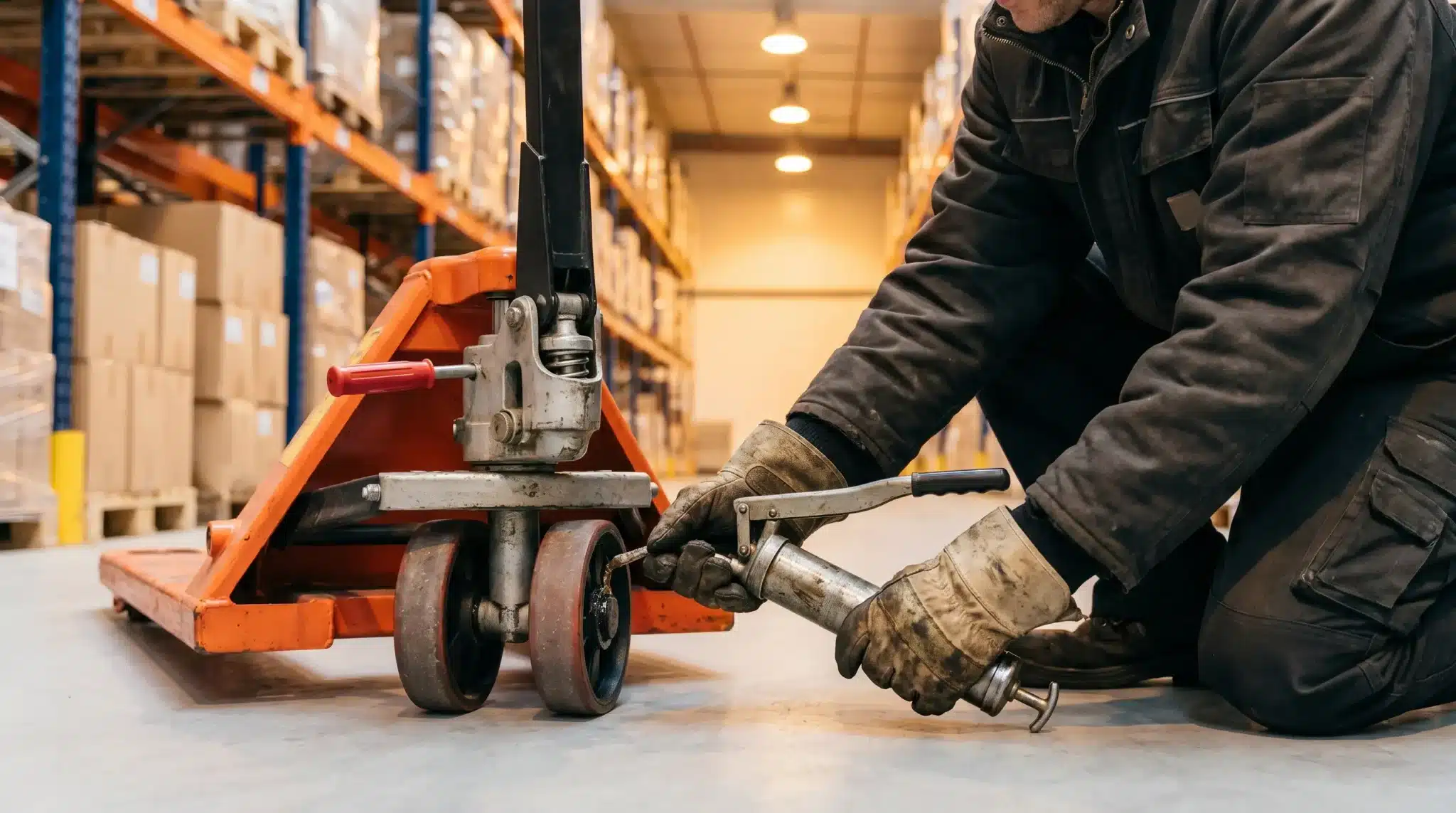
Metal-on-metal contact is the formula for premature wear and noisy warehouse operation. As your pallet jack contains a few grease nipples and pivot points, they need constant lubrication to work properly. Without grease, these parts could get stuck, making it nearly impossible to steer or pump the handle.
Apply lubricant to the steering column and the load wheel axles about once a month using a high-quality grease gun. This will prevent rust from forming and allow each moving part to rotate freely under high pressure.
4. Adjust the Lowering Valve
If your pallet jack does not lower smoothly or will not lift at all, the control lever normally requires a rapid adjustment. Eventually, a chain or rod that connects the handle to the hydraulic valve may become stretched or loosened. This prevents the valve from fully opening and closing when you pull the lever.
Test “drive”, “lift”, and “lower” to ensure the jack responds immediately to each command. A valve that is properly adjusted avoids a state called “drifting”, where a load gradually sinks to the floor while you are attempting to move it.
5. Inspect for Structural Cracks or Bends
The frame and forks of your equipment may experience physical degradation during heavy use and occasional collisions. Look at the forks periodically for evidence of bending or hairline fractures, especially around the joints. A compromised frame is a major safety hazard that could lead to a sudden collapse under a full load.
Just ensure the forks are not twisted or crooked because when you lift an unbalanced weight, the pallets could slide off unexpectedly. If you do find major structural damage, the unit should be taken out of service immediately for professional repair.
Ensure Long-Term Equipment Reliability
With good maintenance, you are turning your everyday tool into a partner you can count on your team to work with every shift. It takes only a few minutes to check the oil and clear the wheels in one go, and it pays off big time.
So care for your manual fleet as much as you care for your motorised vehicles to keep your logistics chain intact. Some preventive care today will keep a big headache from tomorrow.