
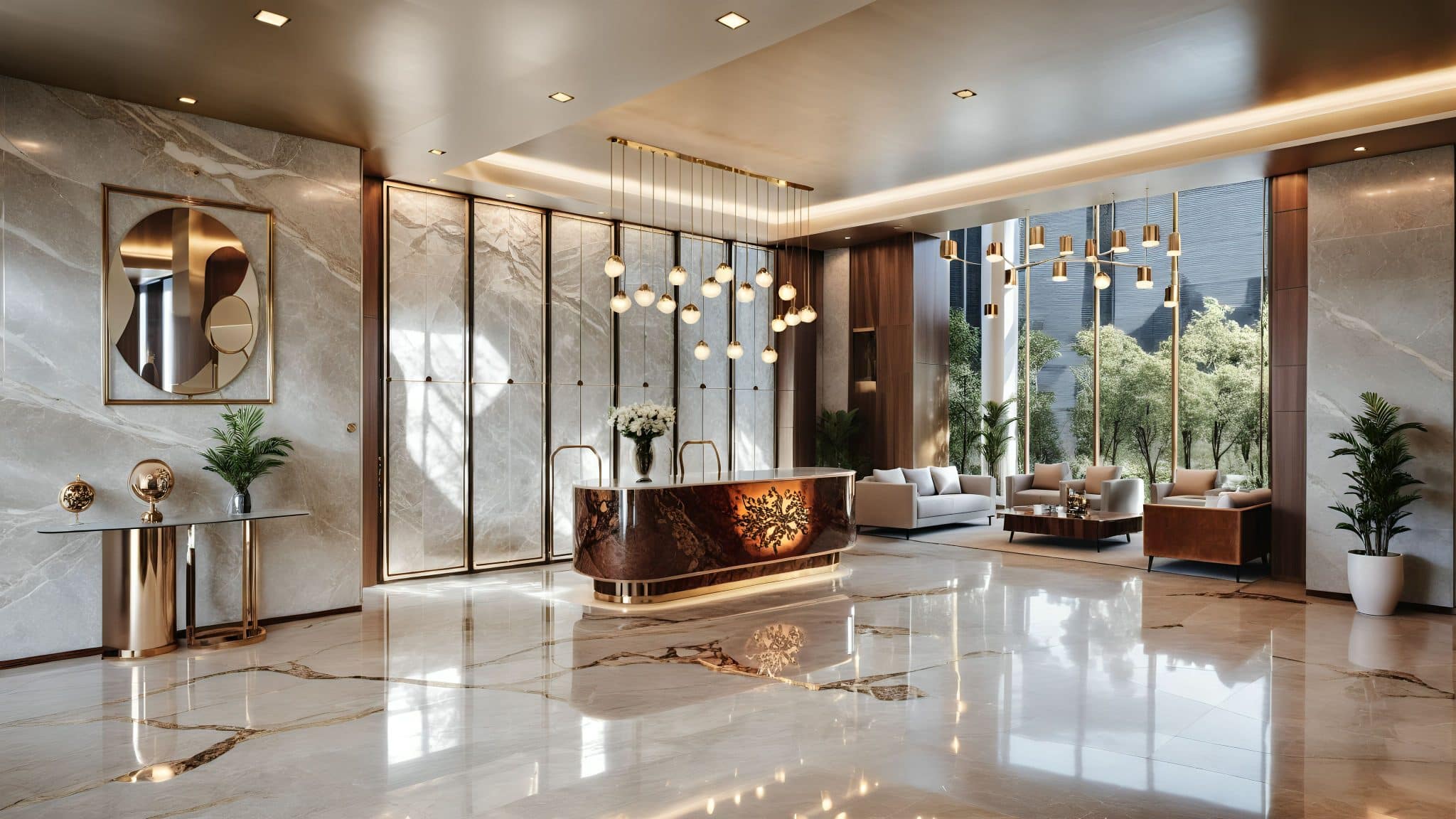
For most of the past three decades, marble has been the default answer to the question of premium flooring in Dubai. It signals quality, reads as luxury, and has been the material of choice for hotel lobbies, villa entrance halls, and high-end residential developments across the city, making it almost synonymous with upscale interiors in the Gulf.
That default is being questioned, and in a growing number of the most considered premium projects in Dubai and across the wider region, terrazzo flooring in Dubai is the answer that’s replacing it. Not because marble has stopped being beautiful, but because terrazzo — specifically modern epoxy terrazzo — delivers something marble can’t: complete design freedom combined with the technical performance Dubai’s demanding conditions require.
What Modern Epoxy Terrazzo Actually Is
The terrazzo that is gaining ground in Dubai’s premium interiors is not the terrazzo of mid-century public buildings — the cement-based material that requires expansion joints, is prone to cracking under movement, and demands significant maintenance to keep its appearance. Modern epoxy terrazzo is a fundamentally different product, sharing the visual vocabulary of traditional terrazzo while being built on a resin matrix that performs differently in almost every technical respect.
Epoxy terrazzo is produced by combining a two-component epoxy resin with marble chips, glass, metal, mother of pearl, or other aggregates, poured and trowelled in place and then ground and polished to a seamless finish. The result is a surface that is harder, denser, and more chemically resistant than cement terrazzo, with a seamless appearance that is achievable in spans that cement-based terrazzo cannot match without the expansion joints that interrupt the visual continuity of the floor.
In the Gulf climate — where thermal movement, humidity variation, and the demands of heavy commercial use are all more pronounced than in more temperate markets — the technical properties of epoxy terrazzo produce a flooring performance that is genuinely more appropriate than cement terrazzo for most premium applications.
The Design Freedom Argument
The most significant advantage of epoxy terrazzo over marble is not technical. It’s creative. Marble comes in the colours, patterns, and visual character that nature produced in a specific quarry at a specific time. The selection available at any point is determined by what has been extracted, cut, and shipped — and while that selection is extensive, it is ultimately constrained by the geology of the source material.
Epoxy terrazzo begins from a different premise. The aggregate mix — the combination of marble chips, glass fragments, metal pieces, and other materials — can be specified to produce almost any visual character the designer is working toward. Colour is controlled through the resin matrix and the aggregate selection, rather than by what is found in a quarry. Pattern and visual texture emerge from how the aggregates are combined and distributed rather than from geological accident.
This design freedom has specific implications for projects where a distinctive floor is part of the design intent. A hotel lobby that wants a floor genuinely specific to that property — a visual identity that cannot be replicated because it was designed rather than selected — can achieve that with epoxy terrazzo in ways marble doesn’t allow. A villa owner who wants the floor to align specifically with the interior’s colour palette and material language can specify the exact aggregate combination and resin colour that achieve that relationship. These are design conversations that marble simply cannot accommodate.
Where Marble Still Has an Argument
The comparison between terrazzo and marble is not a competition with a single winner. Marble makes its strongest case in contexts where the material’s natural variation and depth are part of the design intent — where the veining, the movement, and the sense of geological history that a well-chosen marble slab carries are exactly what the space is meant to communicate.
A grand entrance hall that wants to feel monumental and timeless may still be better served by large-format marble slabs with dramatic veining than by a terrazzo floor, however well-specified. The prestige association of specific marble varieties — the immediate recognition that certain stones carry with an informed audience — is not something that terrazzo replicates, because terrazzo’s value proposition is different: it is a designed material rather than a found one.
The argument for terrazzo over marble is strongest in contexts where design specificity, seamless installation, and technical performance are the primary considerations — and weakest in contexts where the natural material’s inherent character and its association with prestige are the point.
Technical Performance in the Dubai Context
Dubai’s environment places specific demands on flooring that become more apparent over time than they are at the point of installation. Thermal movement — the expansion and contraction of materials in response to temperature variation between air-conditioned interiors and exterior conditions — affects all flooring materials but is particularly relevant for large-format marble installations. The joints between marble slabs, and the adhesive and grout used to set and fill them, are the points where movement-related failure most commonly manifests, producing lippage, cracking, and grout deterioration that affect both appearance and safety.
Thermal movement affects epoxy terrazzo differently from marble because of how it’s built. A continuous pour produces no joints — and joints are where movement concentrates in marble installations, producing lippage, cracking, and grout failure over time. The epoxy matrix distributes stress across the floor plane and is more flexible under thermal load than cement-based adhesive systems. The floor holds its integrity more reliably as a result.
Chemical resistance is where epoxy terrazzo pulls further ahead in hospitality environments. Marble etches. Acidic spills — common in any restaurant or food and beverage setting — leave marks that are difficult to reverse and accumulate over time, resulting in a floor that no longer looks the way it did at installation. Epoxy terrazzo’s resin matrix handles chemical exposure considerably better, reducing the maintenance burden and keeping the floor looking as intended throughout its operational life.
What the Specification Requires
Epoxy terrazzo’s design flexibility and technical performance don’t arrive automatically — they are the product of a correctly specified and correctly installed system, and the specification decisions made before installation begins determine the quality of the outcome.
Substrate preparation is the most important factor in determining the quality of the outcome. Epoxy terrazzo requires a substrate that is structurally sound, adequately cured, and level within defined tolerances. Problems in the substrate — movement, moisture, significant surface variation — don’t stay hidden under the finished floor. They come through it. The quality of the epoxy system applied on top makes no difference if the surface it’s applied to hasn’t been correctly prepared.
Aggregate specification determines the visual character of the floor and must be resolved in detail before any materials are ordered or installation begins. The aggregate size, the combination of materials, the colour of the resin matrix, and the distribution of aggregates across the floor area are all decisions that shape the final appearance and that are very difficult to adjust once the pour is in place.
For architects and designers working on premium Dubai projects, engaging with a specialist who understands both the design and the technical dimensions of epoxy terrazzo — and who can advise an interior design company in Dubai on the relationship between aggregate specification, substrate requirements, and the conditions of the specific project — is where the specification produces the result the design intends.