

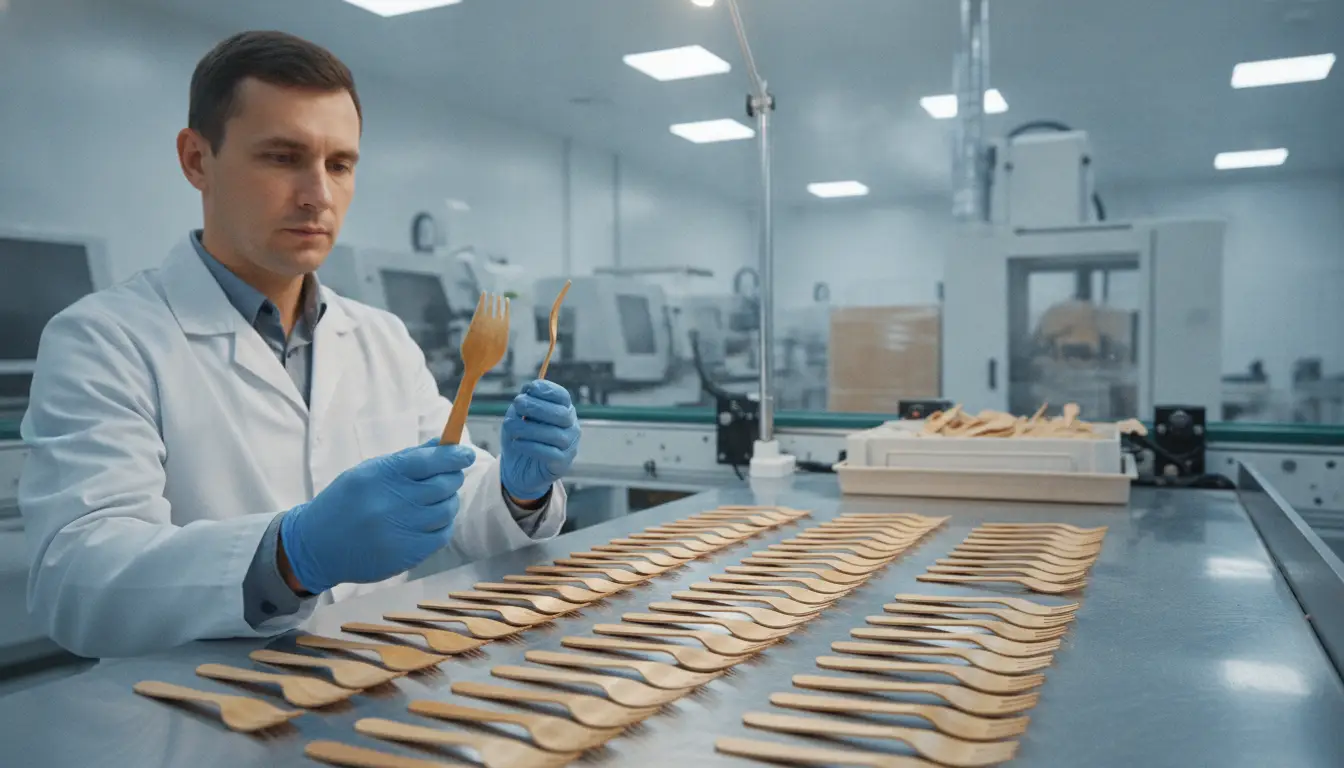
For a foodservice distributor, the catalog is a promise. Every product listed is an implicit guarantee to restaurant groups, caterers, and institutional buyers that what they order will arrive on time, perform as expected, and never embarrass them in front of their own customers. Disposable cutlery sits at the heart of that promise as the plastic-to-wood transition accelerates across the industry.
And the reliability of those wooden forks and spoons traces back to a single decision the distributor makes long before any customer places an order: which wooden cutlery manufacturer to trust.
Choose well, and the product quietly strengthens dozens of accounts. Choose poorly, and one batch of splintering utensils or one missed shipment ripples across the whole book of business. This article breaks down how experienced distributors separate dependable manufacturing partners from expensive risks.
Why the Manufacturer Decision Carries So Much Weight
A distributor’s margins, reputation, and customer retention all rest on supply reliability. Unlike an end operator who can absorb an occasional bad batch, a distributor multiplies every supplier weakness across an entire account base. A 3% defect rate that one cafe might tolerate becomes hundreds of complaints when spread across fifty venues — and each of those complaints lands on the distributor, not the manufacturer.
That structural exposure is why sophisticated distributors treat manufacturer selection as risk management. The question is not simply “is this product good?” It is “can this partner deliver this quality, at this volume, this reliably, for years?”
The market context only raises the stakes: with the EU’s Single-Use Plastics Directive having removed plastic cutlery from shelves across Europe and similar momentum building globally, demand for wooden alternatives is climbing fast — and demand spikes are exactly when unreliable manufacturers fail.
Production Capacity and Consistency Come First
Volume exposes weaknesses that a sample order conceals. The first thing to establish about any prospective supplier is whether they can hold quality steady across hundreds of thousands of units, shipment after shipment, including during seasonal surges.
That strongly favours manufacturers who own and control their production over brokers who repackage stock from shifting third parties. A genuine manufacturer with its own factory can speak precisely about line capacity, defect rates, lead times, and how it absorbs demand spikes without quality slipping. When a supplier controls the factory, it controls consistency — and consistency is the single attribute that keeps distributor accounts loyal year after year.
Concrete questions worth asking:
- What is your monthly production capacity, and what is your current utilisation?
- What is your average defect rate, and how is it measured?
- How do you handle a sudden 40% increase in order volume?
- Do you manufacture in-house or subcontract? If subcontract, to whom?
Certifications That Survive an Audit
Foodservice buyers increasingly demand documentation, and distributors are the ones who get asked for it — often at the least convenient moment, mid-tender or during a client audit. Before listing a manufacturer’s products, confirm they can supply:
- Food-contact safety documentation suitable for every market you serve.
- Responsible-sourcing credentials such as FSC chain-of-custody certification, which verifies timber from responsibly managed forests.
- Quality-management evidence — production controls, inspection protocols, batch records.
A reliable manufacturer treats these as routine. If documentation is slow, partial, or vague, that friction will eventually surface in front of one of your most important clients.
OEM/ODM Capability Protects Your Margins
The distributors with the healthiest margins rarely compete on generic, unbranded product alone — that is a race to the bottom anyone can join. Manufacturers offering OEM and ODM services (custom packaging, private-label runs, branded sleeves, tailored piece counts) let you build differentiated SKUs competitors cannot price-match line for line.
This matters more than it first appears. A branded, compostable cutlery set built to a client’s specification is a value-added product with pricing power; a plain bag of forks is a commodity. OEM/ODM capability is therefore not a luxury feature — it is a margin strategy. When evaluating a manufacturer, treat customization flexibility as a core selection criterion, not a nice-to-have.
Logistics Reliability Is Half the Relationship

A flawless product that arrives three weeks late is a problem, not a win. Distributors live on predictable replenishment, so evaluate a manufacturer’s export track record to your region as rigorously as the cutlery itself:
- Typical and worst-case lead times to your ports.
- Shipping partners and how they handle delays.
- Their process when a shipment is short or held in customs.
- Communication cadence when something slips.
Manufacturers with established export operations to your market have already solved, at someone else’s expense, the problems a newer supplier will encounter for the first time on your order. That hard-won experience is worth paying a premium for.
It is also worth understanding how a manufacturer manages the gap between order and delivery. The best partners treat your forecasts as planning inputs, hold a sensible safety stock of fast-moving lines, and flag capacity or shipping pressures before they become your emergency. Ask prospective suppliers how they handle a sudden surge from a major account, what visibility they can give you into production and shipping status, and how quickly they can expedite when a customer’s needs change. A manufacturer who can answer those questions concretely is one who has built logistics into their operation rather than improvising it order by order — and that difference shows up directly in your fill rates and your customers’ confidence.
Sustainability Claims You Can Defend
Your customers buy wooden cutlery largely to reduce plastic waste, and they will repeat your sustainability claims to their customers. That means the claims must hold. Regulatory and public scrutiny is intensifying — bodies such as the UN Environment Programme keep the scale of plastic waste in the headlines — and overstated marketing is a liability waiting to surface. Partner only with manufacturers whose environmental claims are backed by certification and traceable sourcing, so the story you pass along is one you can stand behind under questioning.
Run a Structured Trial Before Committing
Before staking a major account’s volume on a manufacturer, run a disciplined trial: a representative order, an inspection on arrival against agreed criteria, and a candid review of communication and timeliness. A supplier that performs under that scrutiny is one you can confidently build a catalog around. The trial is cheap; a failed rollout across your top accounts is not.
Red Flags That Signal an Unreliable Manufacturer
Experienced distributors learn to read warning signs early, because the cost of ignoring them compounds across accounts. A few patterns reliably predict trouble:
- Vague answers about production. A supplier who cannot state capacity, defect rate, or whether they manufacture in-house is either disorganised or hiding subcontracting you cannot see into.
- Documentation that is always “coming.” Certifications that never quite arrive are a pattern, not a delay. If safety and sourcing paperwork is hard to get during courtship, it will be impossible during a crisis.
- A price that is dramatically below the market. Disposable cutlery has real input costs. A quote far under everyone else usually means corners cut on wood quality, finishing, or labour conditions — corners that resurface as complaints.
- Slow or evasive communication. How a supplier communicates before you are a customer is the best preview of how they will communicate when a shipment is late.
- No regional references. A manufacturer who cannot point to other buyers in your market may be untested on the exact logistics and compliance issues you will face.
Pricing Models Distributors Should Understand
Margin discipline starts with understanding how a manufacturer prices. Most quotes hinge on a few variables: order volume, packaging complexity, wood grade, and shipping terms. Knowing which lever moves the price lets you negotiate intelligently rather than simply pushing for a lower headline number.
Volume breaks are the most familiar lever, but committed forward volume — a standing order across a quarter or a year — often unlocks better pricing than a single large purchase, because it lets the manufacturer plan production. Packaging is the second lever: plain bulk packing is cheapest, while branded OEM/ODM runs carry setup costs that amortise over larger quantities. Shipping terms matter too; understanding whether a quote is ex-works, FOB, or delivered changes your true landed cost substantially. The distributors who protect their margins are the ones who read the whole quote, not just the per-unit figure at the top of it.
It also pays to build the relationship over time rather than treating every order as a fresh negotiation. Manufacturers reward predictability: a distributor who forecasts accurately, pays on agreed terms, and communicates changes early is a lower-risk customer, and lower risk tends to translate into better pricing and priority during capacity crunches. The cheapest unit price from a supplier you fight with on every order is rarely the best total deal; a slightly higher price from a partner who plans alongside you, holds stock for your fast movers, and answers the phone when something slips usually wins on the metrics that actually determine your service levels and margins.
Key Takeaways and Next Step
- Manufacturer selection is risk management — supplier weaknesses multiply across your accounts.
- Prioritise production control and consistency above headline price.
- Demand defensible certifications (food-contact, FSC) up front.
- Treat OEM/ODM flexibility as a margin strategy, not a bonus.
- Scrutinise logistics and run a structured trial before scaling.
For distributors, choosing a wooden cutlery manufacturer means choosing whose reliability you are willing to stake your reputation on. Prioritise consistency, demand documentation, value customization, and verify with a trial. If you are building out a sustainable serviceware catalog, start by shortlisting an established wooden cutlery manufacturer with in-house production, OEM/ODM capability, and proven export experience to your region — then put them through a real trial order before you commit.