

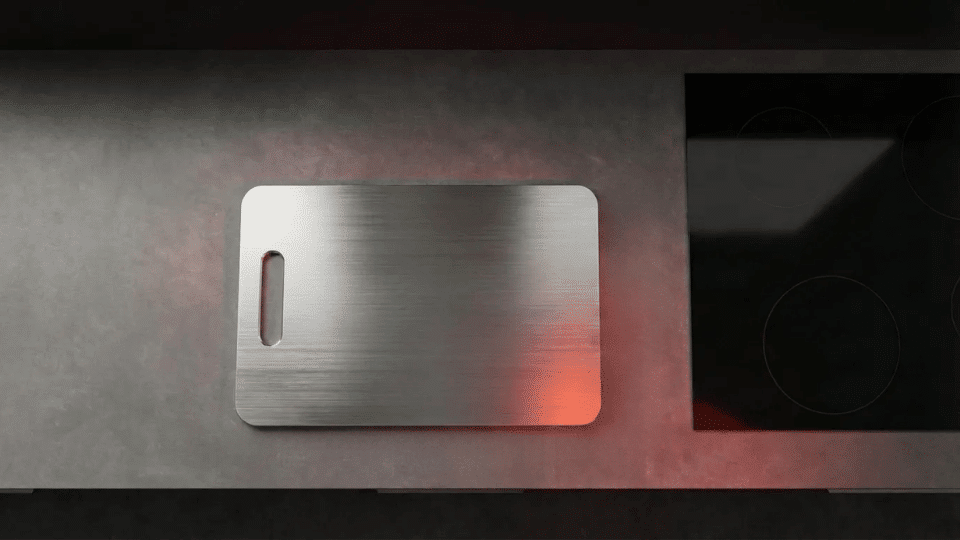
Switching cutting boards sounds simple until you realize how much the wrong surface affects your knife, your food, and your daily prep routine.
Titanium cutting board pros and cons have become a surprisingly heated topic, and once you dig in, it’s easy to see why.
These boards promise a cleaner, longer-lasting alternative to plastic and wood, but come with trade-offs that matter depending on how you cook. From hygiene and durability to knife wear, cost, and spotting a fake board, it’s all covered here.
Are titanium cutting boards good? Keep reading to find out.
Are Titanium Cutting Boards Good?
Most people land on this question after getting frustrated, a plastic board that won’t stop smelling, a wooden one that needs constant oiling, or a growing unease about what’s quietly ending up in food after years of chopping.
Titanium entered the conversation partly because of rising concerns around microplastics in kitchen tools and partly because people simply want something that lasts and stays clean without much fuss.
The short answer is yes, titanium cutting boards are good, but with context. They hold up well over time, don’t absorb odors or stains, and are genuinely easy to clean.
In my experience testing kitchen tools, they perform best as secondary boards for specific tasks rather than as your everyday go-to. If hygiene and durability are your top priorities, titanium delivers. If knife care and cutting comfort matter more, you’ll want to think it through.
Pros of Titanium Cutting Boards
Titanium boards solve problems that plastic and wood boards create over time, and once you use one for the right tasks, the difference becomes hard to ignore.
- No Odors or Stains: Most cutting boards retain odors from raw fish, garlic, or spices. Titanium doesn’t. Its non-porous surface prevents residue buildup, so it rinses clean and smells fresh, ideal for food prep.
- Easy Cleaning: A quick wipe or rinse suffices. Titanium requires no scrubbing, soaking, or special cleaners and is dishwasher safe, making it low-maintenance compared to wood boards that warp or plastic ones that need replacement when scratched.
- Doesn’t Warp or Wear Down: Wooden boards split when drying; plastic boards groove and wear quickly. Titanium maintains its shape and surface regardless of heat or moisture. One titanium board can last for years without replacement.
- No Moisture or Bacteria: Wood absorbs moisture and bacteria, while plastic boards develop grooves trapping food. Titanium’s non-porous surface resists grooving, making cleaning more effective.
Cons of Titanium Cutting Boards
Titanium has real strengths, but it’s not a perfect surface for every kitchen, and a few of its drawbacks are worth knowing before you spend the money.
- Knives Will Dull Faster: Titanium is harder than most knife steel, making your blade’s edge endure more impact and requiring more frequent sharpening. If you use high-quality knives and want to preserve them, consider this trade-off.
- Noticeably Louder: Chopping on titanium produces a sharp, metallic sound that stands out in a quiet kitchen. While not a dealbreaker for most, it can be noticeable during early-morning prep or in small shared spaces.
- Food Slides Around: Titanium’s smooth surface is easy to clean but harder to control when cutting food. Ingredients shift more than on wood, which has natural grip. It’s manageable but slows prep and can remain frustrating for some cuts.
- The Surface Feels Hard: Cutting on titanium offers no give; wrists and hands feel it after long prep. Wood’s softness absorbs impact, unlike titanium’s firm surface. This matters during volume cooking or joint sensitivity.
- High Upfront Cost: A titanium cutting board costs three to five times more than plastic and more than mid-range wood, reflecting its longevity and hygiene benefits rather than cutting comfort. It’s a fair trade, but not a casual buy.
What Real Users Say About Titanium Boards and Knife Damage
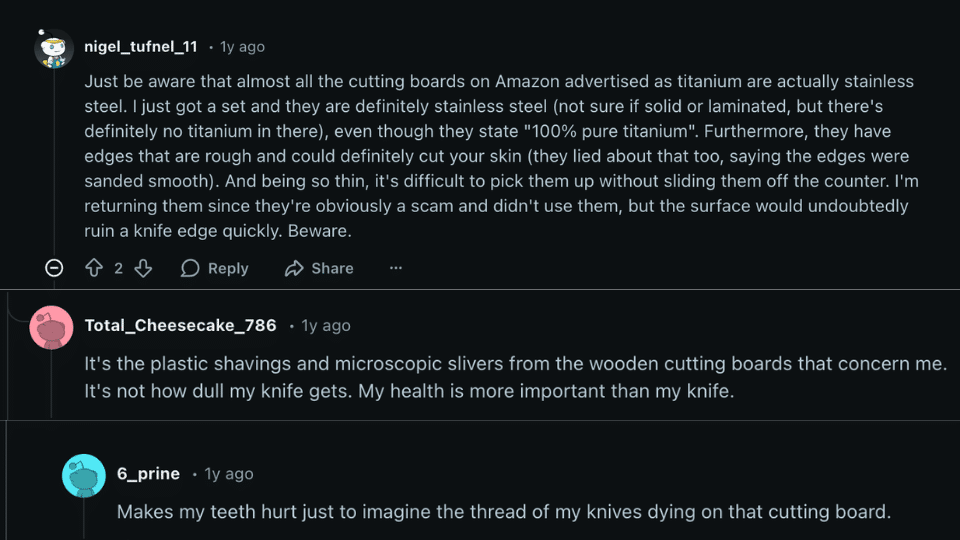
The knife question is where online discussions get heated fast. On r/kitchen, one user put it bluntly, “glass, titanium, ceramic, stainless steel, marble and all of the other fancy cutting boards that are not wood or plastic are just gimmicks, they are AWFUL for your knives.” Fair point, and many agreed.
But the counter came just as quickly, “it’s not how dull my knife gets. My health is more important than my knife.”
Over on r/KitchenConfidential, the skepticism ran deeper, mostly from professionals who’ve spent real time sharpening blades and aren’t willing to compromise. And honestly, that perspective deserves respect.
See, the knife-wear concern is real, but it’s also overstated for casual home cooks. If you’re sharpening regularly anyway, the difference is manageable.
The bigger issue, as several users found out, is buying a board labeled titanium that’s actually steel. That’s what ruins knives. Solid titanium, used for the right tasks, is a different conversation entirely.
How Titanium Compares: Titanium vs. Plastic vs. Wood vs. Stainless Steel
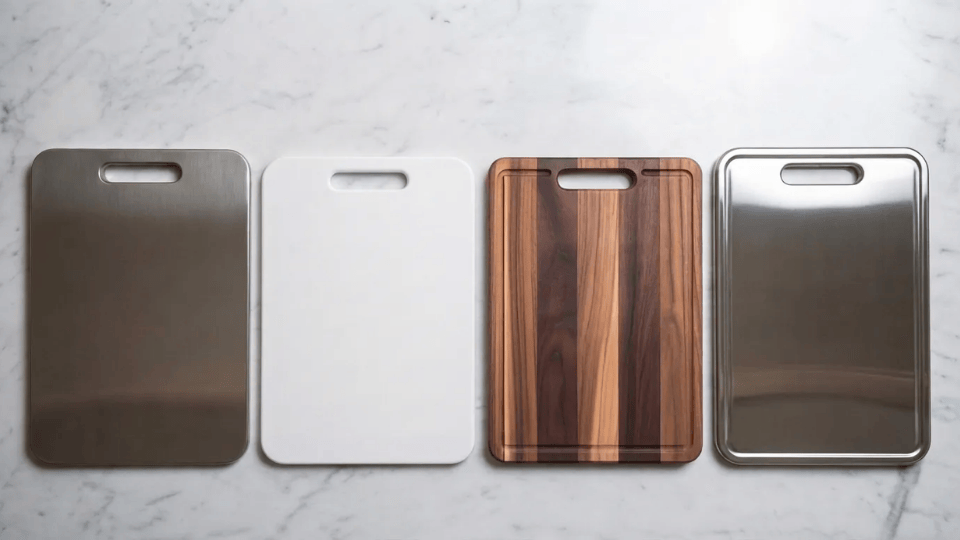
Every cutting board material handles bacteria, moisture, and wear differently. Here’s how the most common options actually stack up:
| Factors | Plastic | Wood | Stainless Steel | Titanium |
|---|---|---|---|---|
| Porosity | Low initially, increases with grooves | High, absorbs moisture | Non-porous | Non-porous |
| Bacteria risk | Grooves trap bacteria over time | Absorbs moisture, and bacteria can survive inside | Low if cleaned properly | Low, no grooves, no absorption |
| Knife friendliness | Good | Best | Poor | Poor to moderate |
| Microparticle shedding | Yes, evidence of plastic particles in food | Minimal, cellulose, mostly harmless | Minimal | None reported |
| Maintenance | Low initially, replace when heavily scored | High, oiling, drying, sanding | Low | Very low |
| Acidic Food Reaction | No | No | Slightly over time | No |
| Durability | Low to moderate | Moderate with care | High | Very high |
Titanium sits at the cleaner end of this spectrum; it doesn’t absorb, doesn’t groove easily, and doesn’t shed material into your food, making it one of the more hygienic surfaces available for regular food prep.
What Makes Titanium Food Safe
Titanium is classified as a biocompatible, non-reactive metal, the is why it’s used in surgical implants and medical devices.
- It doesn’t leach chemicals into food,
- doesn’t interact with acidic ingredients like citrus or vinegar, and
- doesn’t transfer any taste or odor.
At a molecular level, titanium forms a stable oxide layer on its surface, making it highly resistant to corrosion and contamination.
It won’t break down under normal cooking conditions, won’t react to temperature changes in a home kitchen, and doesn’t carry the chemical concerns associated with some coated or composite materials.
For food-contact applications, solid titanium is considered one of the safest materials available.
Fake vs Real Titanium Boards
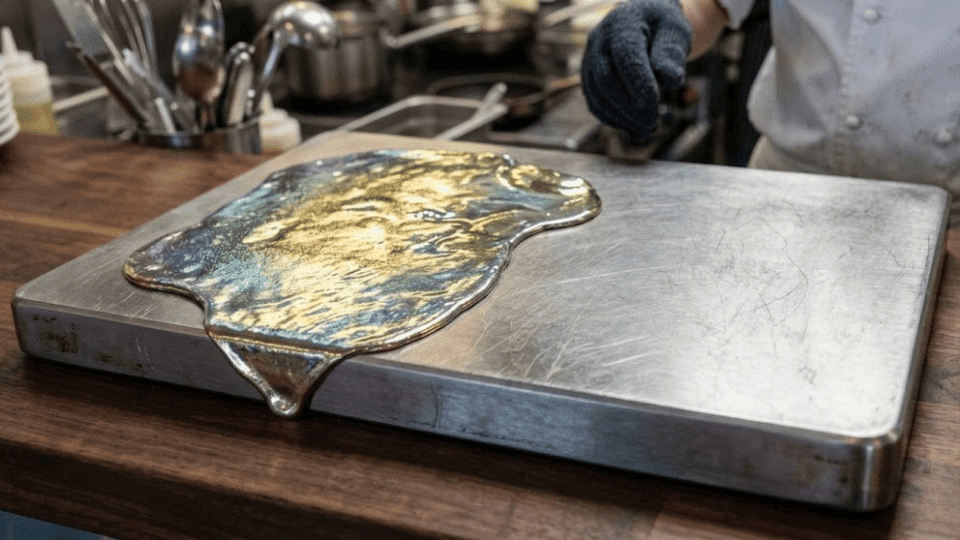
Many buyers learn the hard way that ‘100% pure titanium’ boards often have a steel or aluminum core with a thin titanium coating.
Prices seem reasonable, but surface wear quickly reveals the truth, damaging knives. One user from the above Reddit discussion found they’d paid for steel disguised as titanium.
Before buying, verify the listing states ‘solid titanium’ or ‘pure titanium.’ Vague terms like ‘titanium finish’ or ‘titanium-coated’ suggest layered products rather than solid ones. Food-grade certification also indicates a legitimate board.
Things to look out for:
- Says ‘solid’ or ‘pure titanium’ → good sign
- Says ‘titanium-coated’ or ‘titanium finish’→ it’s layered, not solid
- Price seems surprisingly low → almost certainly coated
- No material certification listed → ask before purchasing
Titanium Cutting Board: Care and Maintenance
Titanium is one of the lowest-maintenance cutting board materials you’ll find, but a few simple habits will keep it performing well for the long term.
- Wash after every use: warm water and mild dish soap are all you need. Titanium doesn’t require special cleaners or antibacterial solutions to stay hygienic.
- Dishwasher safe: unlike wood, titanium won’t warp, crack, or degrade in the dishwasher. Top or bottom rack both work fine.
- Skip the soaking: there’s no need for it. Titanium doesn’t absorb odors or stains, so a rinse immediately after use handles most residue without extended soaking.
- No oiling or seasoning required ever. This is one of the clearest differences from wood boards, which need regular oiling to prevent cracking and drying out.
- Store dry: titanium doesn’t rust or corrode, but storing it dry and upright prevents water pooling and keeps the surface clean between uses.
- Avoid abrasive scrubbers on coated versions: if you have a titanium-coated board rather than solid titanium, abrasive pads can damage the coating over time. Soft sponges are safer.
Overall, titanium asks very little of you. Clean it properly and store it properly, and it will hold up without the ongoing maintenance that wood or even well-used plastic boards demand.
Titanium Boards: Myth vs Reality
There’s a lot of confident misinformation around titanium cutting boards, especially from people who’ve never actually used one. Here’s what the common claims actually look like when you check them.
| Myth | Reality |
|---|---|
| Metal boards keep meat safer | Titanium is non-porous and easier to clean, but it does not kill bacteria on its own |
| Titanium boards are completely hygienic without effort | They resist buildup better than plastic or wood, but still require proper washing after every use |
| They can replace all your other cutting boards | Titanium works best for specific tasks; using it as your only board creates real knife-wear issues |
| All titanium boards are the same | Solid titanium and titanium-coated boards behave very differently over time |
| Titanium boards don’t need any maintenance | They’re low-maintenance, not zero-maintenance; regular washing is still necessary |
End Note
The boards themselves are genuinely useful; the myths just set expectations that reality can’t always live up to.
Know what you’re actually getting, and titanium delivers exactly what it should.






One Response
hello world