
Most buyers spend hours comparing wattage and price but never ask the question that really determines whether solar panels will work for them: which type of solar panel fits their situation. This guide breaks down all three solar panel types across every dimension that matters, so you can make the right call before spending a dollar.
Why Panel Type Is the First Decision, Not the Last
The solar panel market has a visibility problem. Retailers lead with wattage, efficiency ratings, and price per watt. Those numbers matter, but they are secondary to a more fundamental question: what are you actually going to do with the panel?
A 400W rigid panel mounted on your roof will generate more lifetime energy per dollar than almost any other option. That same panel is completely useless to someone living in a van, charging their devices at a campsite, or trying to power a backup battery system in an apartment with no roof access. Conversely, a lightweight folding panel that is perfect for overlanding trips will never deliver the kind of sustained, cost-efficient output that a homeowner needs for a permanent installation.
Choosing the wrong panel type is not just an inconvenience. It means buying a product that is physically incompatible with your installation surface, too heavy to transport, too limited in output to meet your load, or too fragile to survive the conditions you are deploying it in. The three panel types, rigid, portable folding, and flexible, are built on different structural foundations and optimized for different use cases. Understanding those differences is the only reliable way to make a purchase you will not regret.
How Each Panel Type Is Built and Why It Behaves Differently
The performance characteristics of each panel type follow directly from how it is constructed. Before comparing them head to head, it is worth understanding what you are actually buying in each case.
Rigid Solar Panels
Rigid panels are built around a tempered glass front surface, an aluminum alloy frame, and monocrystalline silicon solar cells laminated between the glass and a polymer back sheet. The glass and aluminum frame provide structural rigidity that allows the panel to bear wind loads, snow loads, and decades of thermal expansion and contraction without deforming or cracking.
This construction is what makes rigid panels the standard for permanent rooftop installations. The encapsulation quality is higher than other panel types, which protects the cells from moisture ingress and UV degradation over long periods. EcoFlow’s 400W all-black rigid panel is a representative example, offering a 23 percent conversion rate, an IP68 waterproof rating, and a 10-year product warranty. Rigid panels from quality manufacturers are designed to maintain meaningful output for 25 years or more, which is the basis for their favorable long-term return on investment.
The tradeoff is installation complexity. Rigid panels require mounting hardware, roof penetrations or ballasted racking systems, proper tilt angle calculation, and in most jurisdictions, a permit and professional installation. They are not a same-day solution and are not portable once installed.
Portable Folding Solar Panels
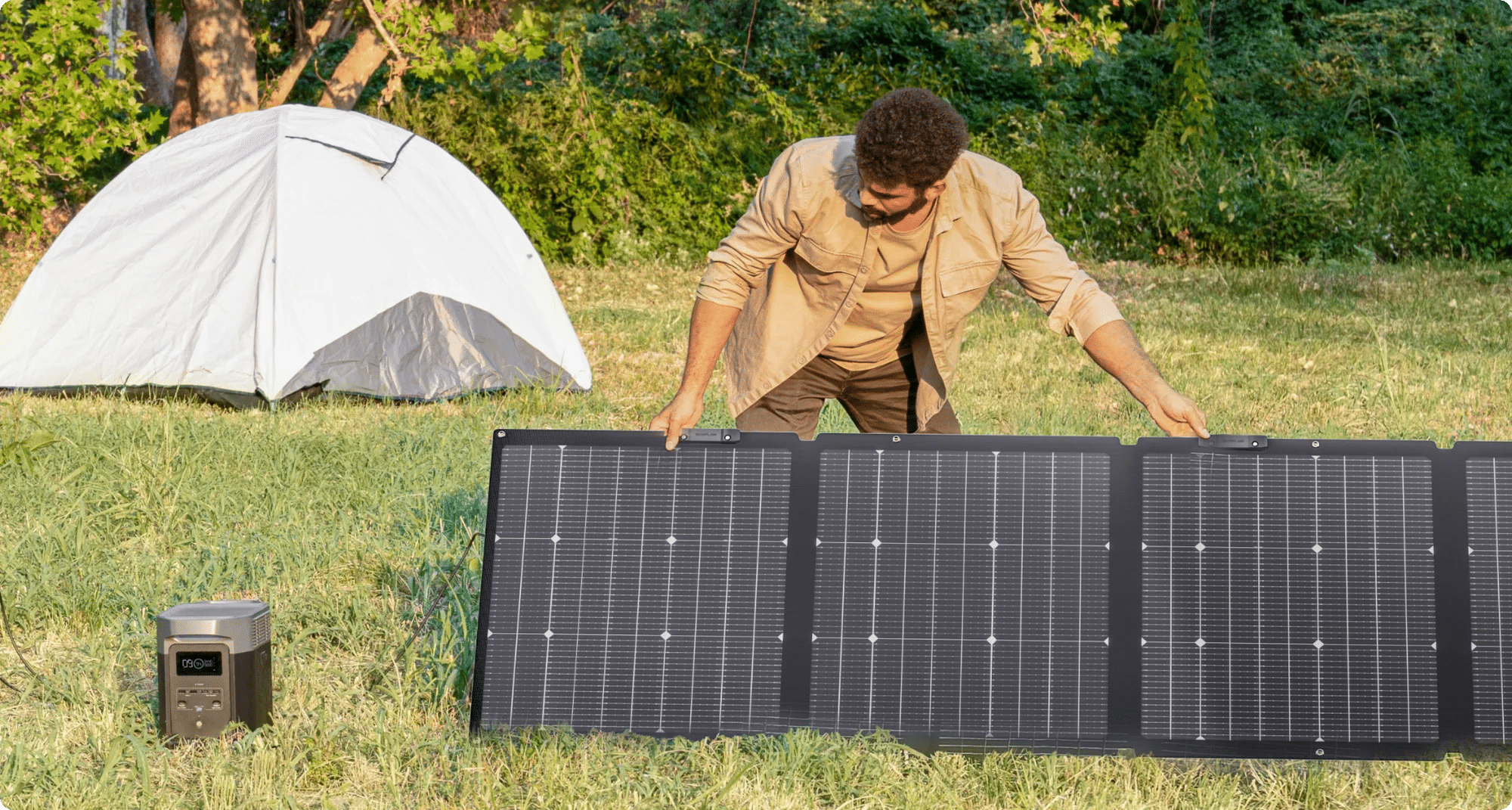
Portable folding panels use monocrystalline silicon cells protected by an ETFE (ethylene tetrafluoroethylene) film surface rather than glass. ETFE is lighter and more flexible than glass while maintaining high light transmission and strong resistance to UV degradation and weathering. The cells are stitched into a foldable fabric or semi-rigid backing that allows the panel to collapse to a fraction of its deployed size.
Most portable folding panels include an integrated kickstand or adjustable support that allows them to be angled toward the sun without any additional equipment. EcoFlow’s portable lineup spans from 45W Type-C direct-charge panels up to a 400W folding panel, with the 220W NextGen bifacial panel sitting at the performance end of the range.
The NextGen 220W uses TOPCon solar cell technology to achieve 25 percent conversion efficiency, the highest available in the portable category, and captures additional energy from ambient light on its rear surface through a bifacial design.
The defining advantage of portable folding panels is zero installation. You unfold them, set the angle, connect to a power station, and start generating. They can be moved, repositioned, and stored in minutes. For buyers who need flexibility above all else, portable panels are the clear choice.
Flexible Solar Panels
Flexible panels take a different structural approach. The solar cells are thinned and mounted on a polymer substrate rather than glass or a rigid backing, which allows the panel to bend around curved surfaces. EcoFlow’s 100W flexible panel achieves 258 degrees of flexibility and weighs just 5.1 pounds, making it the lightest option in the lineup.
The primary application for flexible panels is conforming to surfaces where rigid or folding panels cannot be used: the curved roof of an RV, the deck of a boat, the hood of an overland vehicle, or any installation where minimizing profile and weight is critical. EcoFlow’s RV-specific panel is 12mm thin, reducing driving wind resistance by approximately 60 percent compared to rack-mounted alternatives.
Up to 10 panels can be connected in parallel for a combined output of 1,300W, which covers meaningful RV electrical loads without the drag penalty of a roof rack system.
Flexible panels generally carry a lower efficiency rating than rigid panels of equivalent cell technology, partly due to the thermal challenges of mounting directly against a surface with limited airflow underneath. They are also more vulnerable to physical damage from foot traffic or point pressure loads. The flexibility is a structural feature, not an indication of toughness.
Head-to-Head Comparison Across Six Key Dimensions
Understanding each panel type in isolation is useful. Comparing them directly across the dimensions that drive real purchasing decisions is more useful.
Efficiency
Rigid panels hold a slight advantage in peak efficiency because their glass encapsulation and fixed orientation allow for more precise cell placement and better thermal management when mounted with an air gap. Quality monocrystalline rigid panels reach 23 to 24 percent efficiency under standard test conditions.
Portable TOPCon panels like EcoFlow’s NextGen 220W have closed this gap significantly, reaching 25 percent under the same conditions. Flexible panels typically range from 20 to 23 percent, with efficiency losses compounded by the heat buildup that occurs when they are adhered directly to warm surfaces.
For practical purposes, the efficiency differences between rigid and high-end portable panels are smaller than the real-world variation caused by panel angle, shading, and soiling. The panel type you can deploy at the correct angle consistently will outperform a technically more efficient panel that is poorly positioned.
Durability and Lifespan
Rigid panels, when properly installed, are the most durable option. Their aluminum frames handle mechanical stress, and their glass surfaces resist scratching and UV degradation. A quality rigid panel installed correctly is a 25-year asset.
Portable folding panels are built for durability under transport and deployment conditions. ETFE surfaces resist scratching better than most consumers expect, and IP68 ratings on EcoFlow’s portable lineup mean the panels survive rain, splashing, and even temporary submersion.
The folding mechanism is the component that accumulates the most wear over time, but for the typical use pattern of seasonal camping or periodic emergency deployment, this is not a practical limitation.
Flexible panels are durable in their intended application but vulnerable to misuse. Adhered correctly to a clean, smooth surface with no foot traffic, they perform reliably. Walked on, bent beyond their rated curve, or installed on a surface with sharp protrusions, they degrade quickly.
Installation Complexity
Rigid panels require the most involved installation process. Roof penetrations need to be properly flashed and sealed. Mounting rails need to be anchored to rafters. Wiring needs to run to a charge controller or inverter. Most jurisdictions require an electrical permit and inspection. This is the right approach for a permanent home system, but it is not something you set up on a weekend without preparation.
Portable folding panels require no installation at all. Unfold, angle, connect. The integrated connectors on EcoFlow portable panels are plug-and-play compatible with EcoFlow’s DELTA and RIVER power station series, meaning the entire setup from package to power generation takes under ten minutes.
Flexible panels fall in between. They need to be adhered to a clean surface using appropriate tape or adhesive, with cable routing planned and managed. It is not a complex process, but it is a one-time installation that commits the panel to a specific surface. Removal and reinstallation degrades the adhesive and can damage both the panel backing and the mounting surface.
Portability and Flexibility of Use
Portable folding panels are the clear winner on this dimension. They are designed to be carried, deployed in multiple locations, stored between uses, and repurposed as your situation changes. A panel bought for weekend camping can double as an emergency home backup input the following month.
Flexible panels, once adhered, are committed to that surface. They are portable in the sense that the vehicle or boat they are mounted on can move, but they cannot be repositioned or redeployed elsewhere without significant effort.
Rigid panels are fixed installations. Their portability after installation is zero.
Cost and Long-Term ROI
Rigid panels offer the lowest cost per watt at the point of purchase and the best long-term return on investment for permanent installations, because the long lifespan spreads the initial cost over decades of energy generation. The installation costs add significantly to the upfront investment, but in jurisdictions with net metering or solar incentives, the payback period is typically measured in years, not decades.
Portable folding panels carry a price premium relative to rigid panels of equivalent wattage. That premium buys flexibility, immediate deployability, and compatibility with portable power stations. For buyers who need a backup system without a rooftop installation, the all-in cost of a portable panel plus power station is comparable to a rigid panel system once installation labor is factored in, with considerably more versatility.
Flexible panels occupy a specialty tier where the price reflects the engineering required to produce thin, bendable cells rather than maximum output value per dollar.
Compatibility with Portable Power Stations
Portable folding panels are designed for this use case. EcoFlow’s universal solar connector is compatible with EcoFlow power stations out of the box and works with most third-party portable power stations. The plug-and-play design means no additional components are needed between the panel and the battery.
Rigid panels can feed a home battery storage system directly when connected through a charge controller, but they are not designed to connect to portable power stations without adaptation. They are part of a fixed system architecture.
Flexible panels typically connect through their own cabling and may require a separate charge controller depending on the installation and the power station’s input specifications.
The Right Panel for Each Use Case
The comparison above leads to clear recommendations for each scenario. These are not suggestions to consider. They are the correct answer for each stated situation.
Permanent Home Rooftop Installation
Buy rigid panels. The combination of highest efficiency, longest lifespan, lowest long-term cost per watt, and structural durability makes rigid panels the only logical choice for a roof-mounted permanent system. EcoFlow’s 400W all-black rigid panel delivers a 23 percent conversion rate, IP68 weatherproofing, and a clean aesthetic that works with any roof style. Professional installation is required, and it is worth the investment for a system that will generate power for 25 years.
Home Battery Backup Without Rooftop Access
Buy portable folding panels at higher wattage. If you cannot or do not want to install panels on your roof but still need solar input for a home battery backup system, portable 400W folding panels deployed on a south-facing lawn, deck, or driveway deliver meaningful output without any installation infrastructure. Paired with an EcoFlow DELTA Pro, the system is operational the same day it arrives and can be expanded by connecting additional panels in parallel up to 4,800W of solar input.
Camping, Overlanding, and Off-Grid Travel
Buy portable folding panels in a weight-appropriate wattage. For most camping and overlanding use cases, EcoFlow’s 160W portable panel hits the right balance between power output, packaged weight, and physical size. Buyers with larger power stations or higher loads can step up to the 220W NextGen for improved efficiency in a similarly portable form factor. The 45W and 60W Type-C panels serve as compact single-device charging solutions for minimalist setups.
RV and Van Roof Mounting
Buy flexible panels or EcoFlow’s RV-specific ultra-thin rigid panel. The 12mm profile of EcoFlow’s RV panel reduces wind resistance by approximately 60 percent relative to rack-mounted panels, which matters meaningfully for fuel economy on long highway drives. For RVs with curved roof profiles, the 100W flexible panel conforms to the surface without requiring a mounting frame. Up to 10 panels can be connected in parallel in either configuration.
Boats, Curved Surfaces, and Weight-Critical Applications
Buy flexible panels. When the mounting surface curves in multiple directions, when every pound matters for performance or stability, or when a low-profile installation is required for clearance or aesthetic reasons, flexible panels are the only option that physically fits. EcoFlow’s 100W flexible panel at 5.1 pounds and 258 degrees of bend capability covers the full range of these applications.
Six Mistakes That Lead to the Wrong Purchase
Knowing the correct answer for your use case is only useful if you avoid the most common decision errors that send buyers in the wrong direction.
Treating wattage as the primary selection criterion. A 400W rigid panel and a 400W portable folding panel are fundamentally different products that belong in different situations. Wattage tells you how much power a panel can generate under ideal conditions. It tells you nothing about whether that panel is appropriate for how and where you plan to use it.
Installing flexible panels on high-temperature metal surfaces without an air gap. When a flexible panel is adhered directly to a dark metal surface that heats up in direct sunlight, the panel cells experience elevated operating temperatures that accelerate degradation and reduce output. Where possible, a small air gap or a lighter-colored mounting surface reduces this effect meaningfully.
Deploying portable panels flat on the ground. A portable panel laid flat instead of angled toward the sun can lose up to 30 percent of its potential output, depending on the time of year and latitude. Always use the integrated kickstand and angle the panel toward direct sun for maximum generation.
Assuming flexible means durable under physical load. Flexible panels are engineered to conform to curved surfaces, not to withstand foot traffic, tools being set on them, or contact with abrasive materials. A single point-load impact on a flexible panel can crack the underlying cells, reducing output permanently.
Installing rigid panels without planning for maintenance access. A 25-year rooftop installation will need periodic cleaning and eventual inspection. Panels installed with no clear access path for a person to safely reach them create maintenance problems that compound over time. Installation planning should include how the panels will be serviced.
Purchasing solar panels without pairing them with storage. This applies primarily to portable panel buyers who assume the panel alone will meet their power needs. A solar panel generates power only when the sun is shining. Without a battery to store that power, the panel is useless after dark or during overcast periods. For any use case beyond direct device charging in clear conditions, a paired power station is not optional.
Buying Decision Checklist
Work through the following questions in order. The answers will confirm your panel type and guide your wattage selection.
Identify Your Primary Use Case
- Confirm whether the installation surface is a fixed, flat, or sloped roof structure with structural load capacity.
- Confirm whether the installation surface is a curved vehicle or marine structure that requires conforming coverage.
- Confirm whether the panels need to be moved, redeployed, or stored between uses.
- Confirm whether the system needs to be operational without any installation process or lead time.
Confirm Installation Conditions
- Verify roof mounting requires a permit in your jurisdiction and factor professional installation into total cost.
- Verify the mounting surface material and temperature profile before selecting flexible panels.
- Verify the available surface area and determine whether the required wattage fits within that footprint.
Confirm Performance Requirements
- Determine whether your priority is maximum long-term energy output per dollar, which points to rigid panels.
- Determine whether your priority is performance in variable light conditions, which points to TOPCon portable panels.
- Determine whether your priority is plug-and-play compatibility with a portable power station, which points to portable folding panels.
Confirm System Compatibility
- Verify the solar input specifications of your power station or charge controller before purchasing panels.
- Verify whether parallel connection of multiple panels is supported and plan your expansion path accordingly.
- Verify that your panel selection is paired with sufficient battery storage to cover overnight and cloudy-day load requirements.
The Type Decision Comes Before Everything Else
Solar panel buyers who focus first on wattage and price are solving the wrong problem. The panel that delivers the best value is the one that physically fits your installation, works within your deployment constraints, and aligns with how and where you generate power day to day.
For permanent rooftop systems, rigid panels are the answer. For flexible deployment without installation, portable folding panels are the answer. For curved surfaces and weight-critical applications, flexible panels are the answer. Once the type is right, wattage selection becomes straightforward.
EcoFlow covers all three categories with panels that share common connection standards and compatible power station integration, which means your choice of type does not lock you into a single scenario. A portable folding panel purchased today for camping can become part of a larger home backup system next year. A rigid rooftop array can be supplemented with portable panels during high-demand periods. Building within a single ecosystem keeps your options open as your energy needs change.
Start with the checklist above, confirm your type, and then size for your load. That sequence produces the right outcome more reliably than any amount of comparison shopping on wattage and price alone.