
Finishing a basement sounds simple at first. You picture drywall, flooring, maybe a couch, and assume the cost should be easy to estimate. But then you see numbers ranging from $10,000 to over $100,000, and nothing seems to line up. That’s where most confusion starts.
Basement finishing cost is built layer by layer. Small decisions about layout, plumbing, and permits can shift your total by tens of thousands of dollars.
In this guide, I’ll break down what those numbers really mean, why they vary so much, and how to understand where your project fits. I’ll also flag the mistakes that quietly inflate budgets, because those are the ones most homeowners don’t see coming.
Basement Finishing Cost: Quick Answer & Typical Budget Range
Before getting into details, here’s a clear snapshot of what most homeowners actually spend, and where your project will likely fall.
Average Total Cost Range
Most basement finishing projects fall between $25,000 and $75,000, with a common average around $30,000–$40,000.
For a basic setup, costs can stay closer to $20,000. For larger or more feature-heavy basements, totals can rise beyond $80,000.
This gives you a realistic starting range to work with before getting into the details.
Cost Per Square Foot
You’ll often see costs listed as $30 to $100+ per square foot, which is useful for quick comparisons.
For example:
- Smaller or simpler basements tend to fall on the lower end
- Larger or more complex projects move toward the higher range
However, this number works best as a rough guideline, not a final estimate. Two basements with the same size can have very different costs depending on layout, features, and system requirements.
That’s why understanding what drives those differences is key, and that’s exactly what we’ll break down next.
Basement Finishing Cost Breakdown by Budget Level
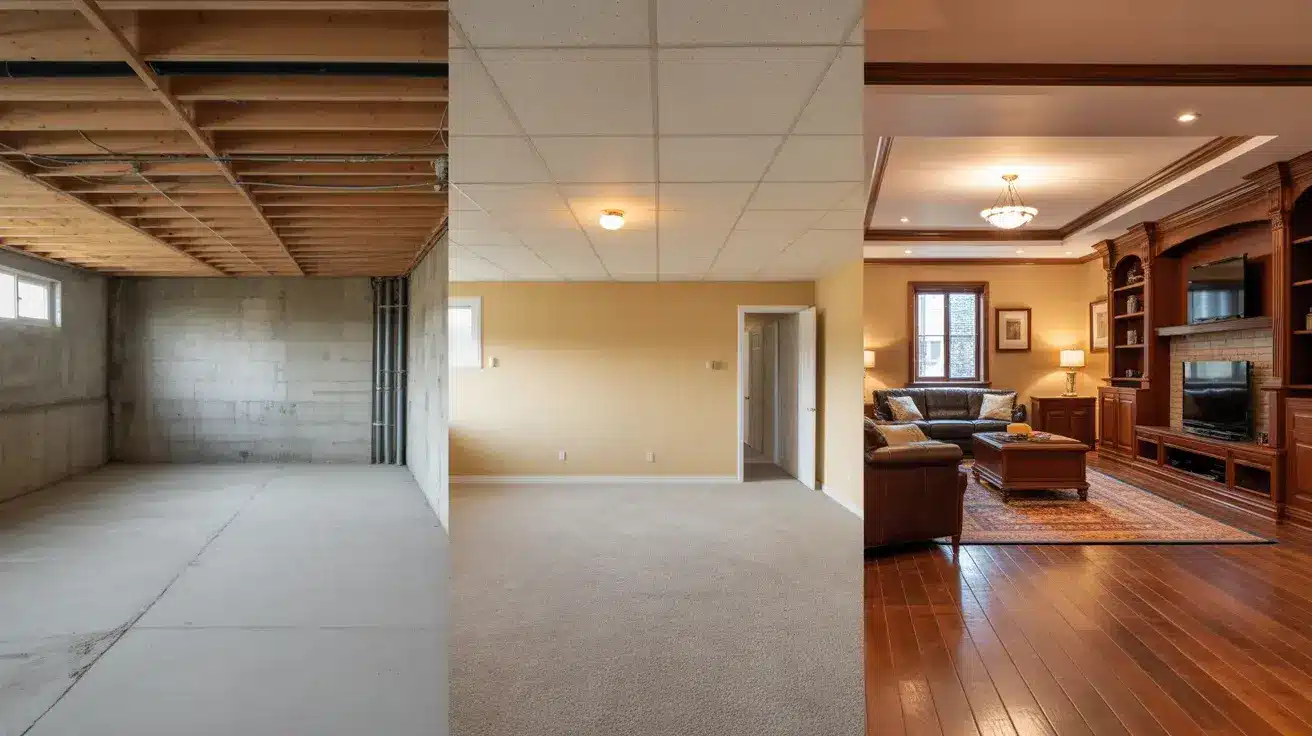
Once you understand the overall range, the next step is seeing what you actually get at different budget levels, and why the price jumps between them.
1. Basic Finish (What’s Included vs Missing)
A basic finish usually falls around $10,000–$20,000.
This typically includes:
- Open layout (few or no rooms)
- Basic flooring and drywall
- Minimal electrical work
What’s missing is just as important:
- No bathroom
- Limited lighting
- Little structural change
The lower cost comes from simplicity. Fewer walls mean less framing, wiring, and labor.
2. Mid-Range Finish (Standard Living Space Scope)
A mid-range project usually lands between $25,000–$50,000.
This is where the basement starts to feel like real living space:
- Separate rooms
- Full lighting setup
- Standard flooring and finishes
- Possibly a small bathroom
Costs increase not just because of better materials, but because the system complexity grows, more wiring, more plumbing, more coordination.
3. High-End Finish (What Drives Costs Higher)
High-end basements often exceed $75,000+.
At this level, cost is driven by:
- Custom layouts
- Bathrooms with full plumbing systems
- Specialty features like bars or theaters
- Structural upgrades (ceiling height, windows)
The jump isn’t just about quality, it’s about adding entirely new systems and requirements.
Cost Examples by Basement Size (What You Might Actually Pay)
Looking at real numbers by size helps make the cost ranges feel more concrete, but it’s important to remember that size alone doesn’t determine the final price.
| Basement Size | Typical Cost Range | Why Costs Behave This Way |
|---|---|---|
| 500 sq ft | $10,000–$25,000 | Smaller spaces often have higher per-square-foot costs because fixed expenses (permits, setup, labor minimums) don’t shrink. |
| 1,000 sq ft | $25,000–$60,000 | Costs vary more at this size depending on layout. Adding rooms or a bathroom increases wiring, plumbing, and labor complexity. |
| 1,500+ sq ft | $50,000–$100,000+ | Larger basements may have slightly lower per-square-foot costs, but total cost rises due to more materials and extended systems (electrical, HVAC, plumbing). |
Even within the same size range, two basements can land at very different price points depending on layout, features, and existing conditions.
Factors That Affect Basement Finishing Cost
Several key factors determine where your project will fall within the overall price range.
These don’t just add small costs, they change how much work is required at each stage, which is why prices can vary so widely.
1. Size vs Layout Complexity
Size plays a role, but layout has a bigger impact on cost. An open basement is cheaper because it needs fewer walls, less wiring, and less labor overall.
Once you divide the space into multiple rooms, each section requires framing, electrical outlets, and lighting. This increases coordination and labor time, meaning complexity multiplies cost rather than simply adding to it.
2. Basement Condition (Moisture, Structure, Height)
The starting condition of your basement can significantly affect your budget. If there are moisture issues, waterproofing must be done before any finishing work begins.
Low ceilings may require structural adjustments, and uneven floors may need leveling. These upgrades aren’t visible in the final design, but they are essential and can add substantial upfront costs.
Waterproofing isn’t optional. Finishing over a damp basement and then addressing moisture problems later can cost $500 to $3,500 in mold remediation alone, and far more in structural repairs.
Interior waterproofing typically runs around $3,000; exterior waterproofing averages $7,000. This work must happen before any framing, drywall, or flooring goes in.
3. Labor vs Material Cost Differences
Labor is often the largest portion of basement finishing cost. Even if you choose basic materials, skilled work like electrical wiring or plumbing remains expensive. labor typically accounts for 20% to 40% of the total project budget, and that share rises when complex trades like electrical or plumbing are involved.
As the layout becomes more complex, labor time increases as well. This means switching to higher-end materials may raise costs slightly, but adding complexity can drive the total much higher.
4. Permits, Codes, and Location Impact
Local building codes and permit requirements can directly influence your total cost. For example, adding a bedroom may require an egress window for safety, and electrical systems must meet strict standards.
Permit fees and inspections also add time and expense. These requirements are mandatory, so they can shift your budget even if your design stays the same.
Permit fees for basement finishing typically range from $500 to $2,000 depending on your municipality and project scope. Your contractor will usually pull the permits and roll the cost into their quote, always confirm this upfront before signing.
One critical point many homeowners miss: skipping permits isn’t just a code violation.
Unpermitted work can void homeowner’s insurance claims related to that space, and it can force costly tear-outs when you sell. Some homeowners have faced $2,000 to $10,000 in corrections just to pass inspection before closing.
Where Your Money Actually Goes (Full Cost Breakdown)?
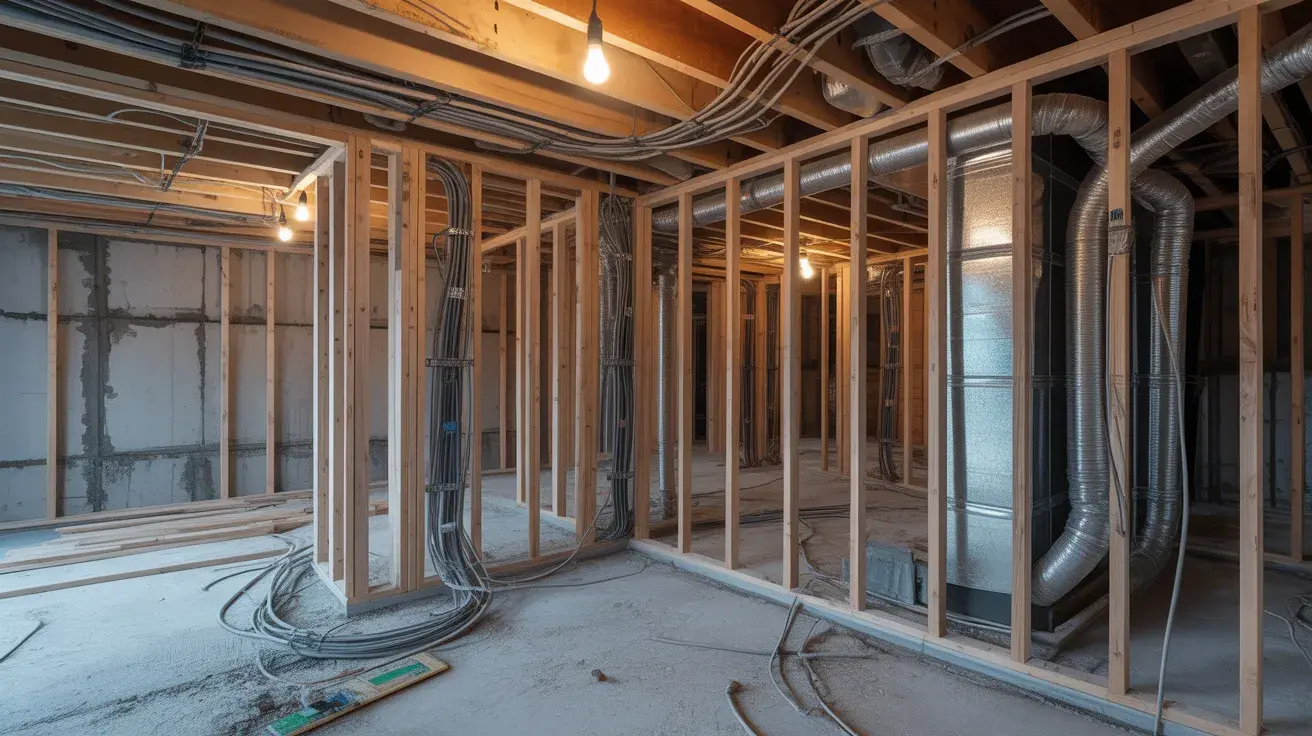
Basement finishing costs build layer by layer. Some parts are visible, but much of your budget goes into work you don’t see. Each stage connects to the next, which is why costs stack.
- Structural & Prep Work: Starts the project. Includes framing, insulation, and fixing moisture or surface issues. It doesn’t change the look yet, but it’s critical for everything that follows. Framing runs $7 to $16 per square foot; insulation adds $0.30 to $6.75 per square foot depending on type.
- Core Systems (Electrical, Plumbing, HVAC): Makes the space usable. Electrical work for a 1,000 sq ft basement typically costs $3,000 to $5,000. Plumbing for a full bathroom runs $2,500 to $5,000. HVAC extensions to serve the finished space add another $3,000 to $10,000. Covers wiring, plumbing, and airflow systems. Costs are higher here due to skilled labor and code requirements.
- Surface Finishes (Walls, Flooring, Ceilings): Shapes the final look. Drywall installation runs $1.50 to $3 per square foot. Flooring typically costs $1,500 to $4,500 total depending on whether you choose carpet, luxury vinyl, or engineered hardwood. This is the visible layer, but not the biggest cost driver.
- Fixtures & Functional Additions: Completes the space. Includes lighting, storage, bathrooms, and features. Each addition connects to earlier systems, increasing total cost.
How Specific Features Increase Your Basement Finishing Cost
Certain features can significantly raise your total cost because they require additional systems, structural changes, or code compliance, not just simple upgrades.
| Feature | What’s Required | Why It Increases Cost |
|---|---|---|
| Adding a Bathroom | Plumbing lines, drainage systems, venting, code compliance | It’s not just fixtures, it requires a full plumbing system, proper drainage, and permits, making it one of the most expensive additions. |
| Bedrooms (Egress Requirements) | Egress windows, proper layout and spacing | Safety codes require egress windows for any sleeping area. Window materials and installation cost $200 to $950 per window, but cutting into the foundation wall to create the opening can push total egress costs to $2,500 to $7,000 per window. |
| Ceiling Changes | Rerouting pipes/ducts, structural adjustments | Basements often have low or obstructed ceilings. Modifying them requires moving systems or altering structure, which adds labor and difficulty. |
| Specialty Features (Bars, Theaters, etc.) | Electrical, plumbing, custom carpentry | These features combine multiple systems. Each one adds layers of work, so costs increase quickly as complexity builds. |
As you can see, each feature doesn’t just add cost on its own, it increases the overall complexity of the project, which is what drives the total price higher.
How Long Does It Take to Finish a Basement?
Timeline is something most cost guides skip, but it matters for planning, especially if you’re timing a home sale or need the space by a specific date.
A professionally finished basement typically takes 8 to 12 weeks from permit approval to final inspection for a mid-range project. Larger or more complex builds can run 12 to 16 weeks. Permit delays, material lead times, and contractor scheduling can add several weeks on top of either estimate.
A practical rule: build in a 20% buffer beyond whatever timeline your contractor provides. Most projects run at least that much longer than the original estimate.
Is Finishing a Basement Worth the Cost?
Finishing a basement often returns around 70–80% of its cost in home value, but that number only tells part of the story. The real value depends on how the space is used and how broadly it appeals.
- Resale Value Impact: A finished basement can increase home value, but rarely dollar-for-dollar. Buyers see it as bonus space, not always equal to above-ground living areas.
- Everyday Usability: Turning an unused basement into a living area, workspace, or guest room adds daily value. This is where many homeowners get the most return, not in resale, but in how often the space is used.
- Customization vs Broad Appeal: Highly personalized features (like home theaters or niche designs) may not appeal to future buyers. Simpler, flexible layouts tend to hold value better.
- Market and Location Factors: In areas where finished basements are common, they may be expected. In others, they can stand out more and add stronger resale appeal.
So the value isn’t fixed, it depends on how well the finished space fits both your needs now and general buyer expectations later.
The key shift is this: it’s not just an investment in resale, it’s an investment in usable space.
Common Mistakes That Inflate Basement Finishing Costs
Most budget overruns don’t come from one big decision. They come from a handful of overlooked items that compound. These are the ones worth knowing before you start:
- Skipping waterproofing: Finishing over a damp basement and addressing moisture problems afterward can cost $15,000 to $25,000 in mold remediation and material replacement.
- Pulling no permits: Unpermitted work can force expensive tear-outs at resale and may void insurance claims tied to that space.
- Choosing moisture-incompatible flooring: Hardwood and standard laminate in a basement that hasn’t been properly moisture-tested often need replacement within a few years, adding $3,000 to $8,000 in avoidable costs. Luxury vinyl plank (LVP) is widely recommended for basements because it’s fully waterproof and durable.
- Ignoring HVAC capacity: Many contractors finish the space without verifying whether your existing HVAC system can handle the additional square footage. Retrofitting a new zone or unit afterward adds $3,000 to $7,000.
- Planning a bedroom without confirming egress requirements: Discovering after the fact that the window opening requires cutting into the foundation wall routinely adds $2,500 to $4,000 to projects that didn’t budget for it.
Final Takeaways
Basement finishing costs can feel confusing at first, I’ve seen how easy it is to get stuck between widely different numbers.
But once you understand how everything connects, the pricing starts to make sense.
It’s not just about size or materials; it’s about how many layers your project requires and how complex each one becomes.
A simple layout keeps costs lower, while adding rooms, plumbing, or custom features increases both effort and price.
Instead of chasing exact numbers, focus on where your project fits within the range. That shift helps you plan with clarity and avoid surprises. For a deeper understanding, go with more detailed basement planning and budgeting guides available across our website.
Frequently Asked Questions
Can you finish a basement for $5,000?
In most cases, no. That budget usually covers minor cosmetic updates only. Full finishing requires structural work, electrical, and compliance, which quickly increases the total cost.
How much does a 1,200 sq ft basement cost?
A 1,200 sq ft basement typically costs $30,000–$70,000. Simpler layouts stay lower, while adding rooms, bathrooms, or upgrades pushes the cost higher.
How much does a 1,500 sq ft basement cost?
Costs usually range from $50,000 to $100,000+. Larger spaces need more materials and extended systems, which increases total cost even if the per-square-foot cost drops.
Is $15,000 enough to finish a basement?
It may cover a basic finish with minimal features. Adding rooms, plumbing, or higher-quality finishes increases complexity and cost beyond this budget.
What flooring is best for a finished basement?
Luxury vinyl plank is widely preferred due to its waterproof nature and durability. It handles moisture well. Tile suits wet areas, while wood or laminate needs proper moisture control.